
Practical
Azerbaijan Travel Essentials: Visa, Money, Safety and Language
The practical questions answered in order: entry rules, the manat, getting around, and what to know before you land.
This is the page for the questions that have to be answered before the interesting ones. Entry rules, money, safety, language, and the handful of local specifics that catch visitors out.
One caveat that applies to all of it: rules change, and the ones about visas and customs change without much notice. Everything here is accurate as far as we know it, and anything that affects whether you can board a plane should be confirmed against an official source for your own passport rather than against any travel guide, ours included.
The short version
- Most nationalities need a visa, and most can get an e-visa online in advance through the official ASAN Visa portal.
- The currency is the Azerbaijani manat. Cards work widely in Baku, cash is needed outside it.
- Azerbaijan is generally regarded as safe for visitors, with low street crime.
- Azerbaijani is official, Russian is widely spoken, English is common in tourism and scarce outside it.
- The land border with Armenia is closed, and an Armenian stamp can complicate entry.
Visas and entry
Most nationalities require a visa to enter Azerbaijan, and most eligible travellers use the e-visa, applied for online in advance through the official ASAN Visa portal. It is issued electronically, usually within a few working days, with an urgent option for a higher fee. Standard tourist e-visas are typically single entry with a thirty day stay.
Some nationalities are exempt, several have different processes, and a few must apply through an embassy. The list changes. Check the official portal for your own passport before you book flights, and be wary of the many lookalike sites that charge a markup to submit the same form.
Print your e-visa or have it available offline. You will be asked for it at check in and again at passport control, and relying on airport wifi to retrieve it is a bad plan.
Two country specific points. The land border with Armenia is closed, and travel between the two is not possible directly. Separately, travellers who have visited Nagorno-Karabakh without Azerbaijani authorisation have historically faced entry problems. If either touches your travel history, get advice before you book.
Money, and where not to change it
The currency is the Azerbaijani manat, written AZN and usually shown with the symbol ₼. Notes run from one to two hundred manat, and the buta motif on them is the same teardrop pattern you will see on every carpet in the country.
Cards are accepted almost everywhere in Baku: restaurants, shops, taxis, museums. Contactless is normal. Outside the capital the picture thins quickly, and the bazaars, roadside stalls, mountain guesthouses and some entry ticket offices are cash only.
Airport exchange counters are convenient and give the worst rates. Change a small amount there if you need it, then use the exchange offices in the city, which are competitive and plentiful, or an ATM. Rates in the offices along Nizami Street are usually as good as you will find.
Azerbaijan is inexpensive by European standards for food, transport, entry tickets and tours. Central Baku hotels are the exception and can approach European prices in peak season.
Tipping is not built into the culture the way it is in North America. Rounding up, or around ten per cent at a proper restaurant, is generous. Check the bill first, because some restaurants in the centre already add a service charge.
Safety
Baku and the main tourist regions are generally regarded as safe, with low levels of street crime. Walking in the centre at night is normal and women travelling alone report fewer problems than in many European capitals. The usual precautions apply and are usually enough.
The realistic risks are mundane. Unofficial taxi drivers at the airport overcharging, occasional inflated bills at tourist facing restaurants, and traffic. Baku drivers are assertive, pedestrian crossings are treated as a suggestion by some, and underpasses exist for a reason.
The genuine restriction is geographic. Border areas, particularly near Armenia and in the territories affected by the conflict, carry travel advisories and some require permits or are closed outright. There is unexploded ordnance in parts of the formerly occupied territories. No normal tourist itinerary goes near any of this, and ours do not, but do not improvise a route into a border region.
Check your own government's current travel advice before you travel. It is the only source that will be up to date and specific to your nationality.
Language
Azerbaijani is the official language, a Turkic language written in the Latin alphabet, close enough to Turkish that speakers of one can follow much of the other.
Russian is widely spoken, particularly by older people and in Baku, and remains a genuine second language for a large part of the population. English is common among younger people and in anything tourist facing, and scarce once you are outside the capital.
A few words go a long way and are received warmly. Salam for hello, sağ olun for thank you, bağışlayın for excuse me, nə qədər for how much. Nobody expects a visitor to attempt more.
Our drivers work in English, Russian, Urdu, Arabic and Azerbaijani. Tell us your preference when booking and we assign accordingly rather than hoping it works out, which matters more than it sounds once you are outside Baku and your driver becomes your interpreter.
Connectivity, transport and the small things
SIM cards are sold at the airport and in the city, and registration requires your passport. An eSIM bought before you fly is usually cheaper and means you land connected. If you are staying more than a few weeks, ask about the device registration requirement, which can block an unregistered handset from the local network.
Baku's metro is cheap, clean and useful for the central area, and it uses a rechargeable card rather than cash. Several stations are worth seeing for their own sake. Buses use the same card. Ride hailing apps operate and Bolt is the most used.
Beyond the city, public transport becomes the constraint rather than the solution. The sites worth travelling for are dispersed, poorly served, and in several cases depend on reaching a specific place at a specific hour. That is the practical case for a private vehicle, whether as a tour or as a car with a driver.
Tap water in Baku is generally considered safe but most people drink bottled, which is cheap and everywhere. Electricity is European standard, 220 volts with the two pin plug.
Etiquette, briefly
Azerbaijan is secular in practice and visitors are not expected to observe religious customs, but a few things are worth knowing.
For mosques, cover shoulders and knees, and women should cover their heads. Carry a light scarf and the question never arises. Shoes come off at the door.
Martyrs' Lane at Highland Park is a place of national mourning rather than a viewpoint with a monument on it. Photograph with some restraint.
Hospitality is taken seriously and refusing tea reads as odd. If you are invited to someone's home, accepting is the normal response, and bringing something sweet is the normal gesture.
Photographing military installations, border posts and some government buildings is not permitted. If there is a guard, assume not.
Frequently asked questions
Do I need a visa to visit Azerbaijan?
Most nationalities do, and most eligible travellers can apply for an e-visa online in advance through the official ASAN Visa portal. It is usually issued within a few working days. Requirements vary by passport and change, so check the official portal for your nationality before booking flights.
What currency is used in Azerbaijan?
The Azerbaijani manat, written AZN. Cards are accepted almost everywhere in Baku including taxis, but carry cash for bazaars, smaller towns, mountain guesthouses and some entry tickets. Airport exchange counters give the worst rates; use the city offices or an ATM.
Is Azerbaijan safe for tourists?
Baku and the main tourist regions are generally regarded as safe, with low street crime. The realistic risks are unofficial airport taxis and assertive traffic. Border areas near Armenia and the formerly occupied territories carry advisories and should not be improvised into a route. Check your own government's current advice.
Do people speak English in Azerbaijan?
Commonly among younger people and in anything tourist facing in Baku, much less so outside the capital. Azerbaijani is official and Russian is widely spoken, particularly by older people. Our drivers work in English, Russian, Urdu, Arabic and Azerbaijani.
Can I travel between Azerbaijan and Armenia?
No. The land border is closed and direct travel between the two is not possible. Travellers who have visited Nagorno-Karabakh without Azerbaijani authorisation have historically faced entry problems, so seek advice if that applies to you.
Is Azerbaijan expensive?
Considerably cheaper than European destinations for food, transport, entry tickets and tours. Hotels in central Baku are the exception and can approach European prices in peak season.
Do I need to tip in Azerbaijan?
It is not obligatory or culturally built in. Rounding up, or about ten per cent at a proper restaurant, is generous and normal. Check the bill first, as some central restaurants already add a service charge.
Places mentioned in this guide
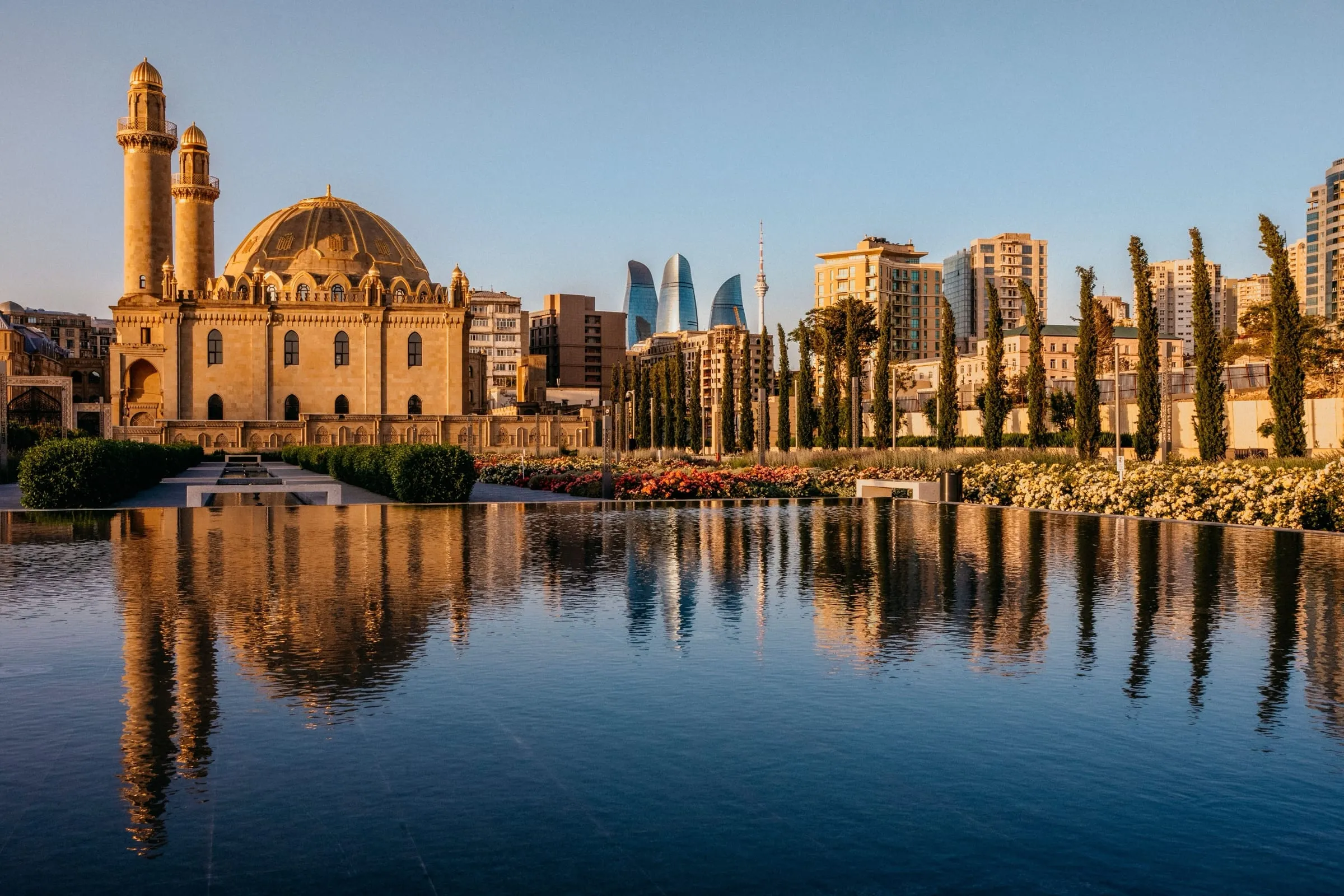
Baku
Azerbaijan's capital on the Caspian. A UNESCO-listed walled Old City ringed by modern towers and seafront parkland.
Ready to plan your trip?
Tell us your dates and group size and we will put together the right itinerary and vehicle.
Or call +994 77 199 17 55 , 08:00 to 20:00, 7 days a week